
Home / Closet Cases / Closet Systems Compared
Closet Systems · 7 min readRail vs. Modular vs. Custom Wall vs. Custom Floor Closet Systems
Shopping for a closet, you'll run into four kinds of systems — rail, modular, custom wall-mounted and custom floor-based. Rail and modular are the off-the-shelf options. The two we build are the custom ones — cabinetry made to the exact inch of your space, in furniture-grade materials, and priced well below the national brands. Here's how all four compare, and how to choose.
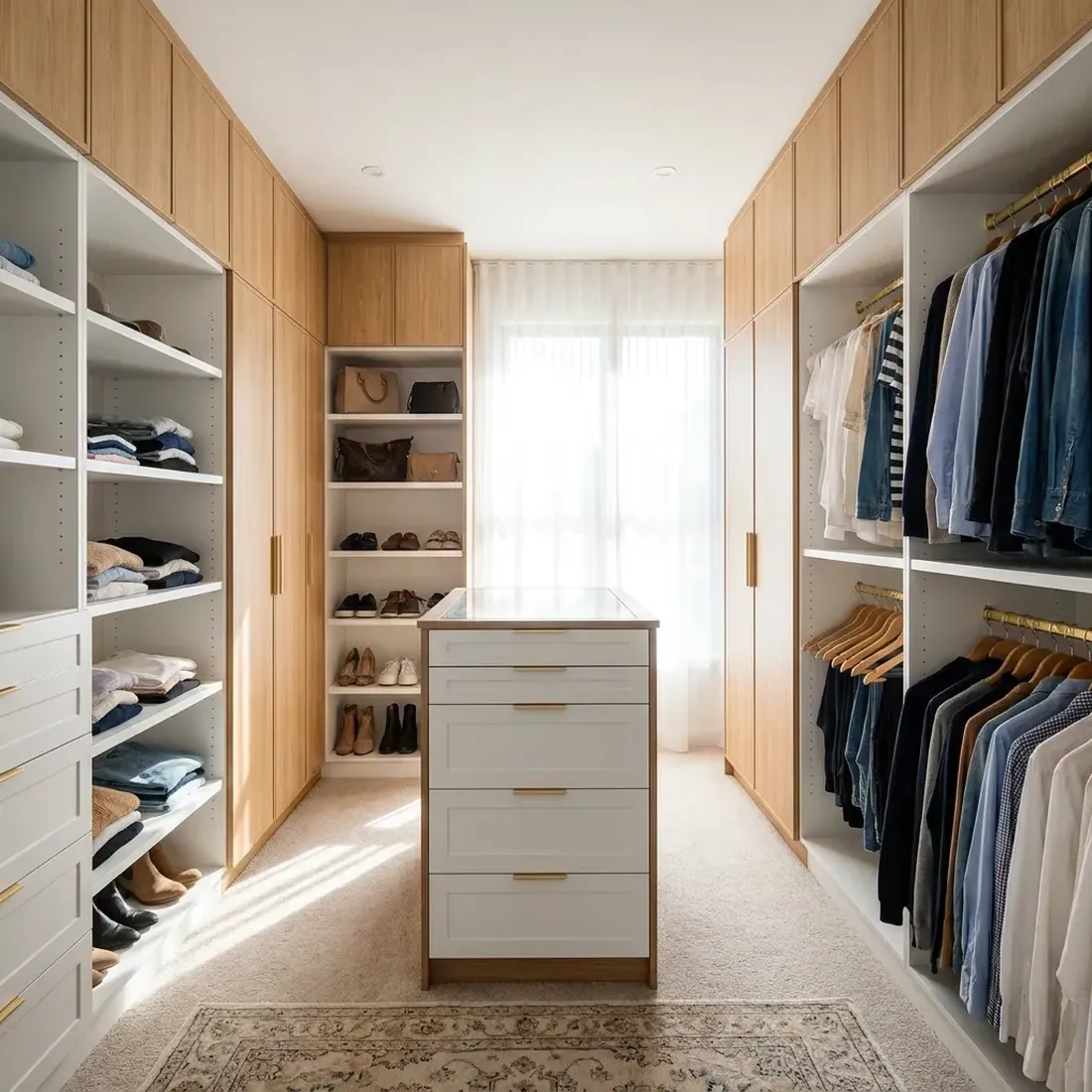
When you start pricing closets, you'll meet four kinds of systems. Two are off-the-shelf — rail and modular — and two are truly custom — custom wall-mounted and custom floor-based. The custom pair is what National Closet Company builds: cabinetry made to the exact inch of your space in furniture-grade laminate and thermally fused melamine (a décor paper fused to a particleboard or MDF core, per the Composite Panel Association), and priced well below the national custom brands. Here's the honest breakdown of all four.
The one-minute version
- Rail (wall-mounted track): the off-the-shelf track option — wire or laminate shelves that clip to a wall-mounted track. With Elfa, only the top track goes into the wall and everything else hangs from standards on it; Organized Living's freedomRail works the same way, with uprights hanging from one rail and parts you can move later without tools. Adjustable, but limited in looks and capacity, and not built to your space. On price, it depends how much you hang on it. A plain rail reach-in is the cheapest way in, starting around $700 installed against roughly $1,000 for one of our custom reach-ins. Add drawers, baskets and accessories and a loaded rail wall climbs into custom territory, while keeping that open, utilitarian, garage-shelving look.
- Modular (freestanding): pre-made cabinet units you set side by side. More furniture-like than rail, but it's not custom — you're fitting standard-width boxes into a non-standard closet, so you can end up with large gaps to fill at the ends and around the units. Modular pieces also don't share vertical panels: where two units meet you get two side panels back-to-back (a doubled-up seam), much like assembling separate IKEA cabinets next to each other, instead of one continuous built-in run. IKEA's own PAX planning guide gives the frame widths as 19⅝, 29½ or 39¼ inches, so unless your wall happens to be a sum of those numbers, there's a gap to fill. And it's no bargain either — for the same design, modular usually costs the same or more than a true custom closet.
- Custom wall-mounted (floating) — we build this: furniture-grade cabinetry built to your exact space that hangs off the wall with the floor open underneath. A lighter, modern look that makes the room feel bigger and is easy to clean under.
- Custom floor-based (floor-standing) — we build this: furniture-grade cabinetry built to your exact space that sits on the floor with a toe kick, like fine built-in furniture. A substantial, high-capacity feel that supports islands and seating.
Between our two custom lines, neither is better than the other — it's a matter of the look you prefer and your room. (In a carpeted room, a floating wall-mounted system is usually the better fit — it keeps the carpet clear.) You can even mix the two in one closet. We walk through it in detail in our custom wall-mounted vs. custom floor-based guide.
Side-by-side comparison
| Rail | Modular | Custom Wall | Custom Floor | |
|---|---|---|---|---|
| Mounting | Wall track, floats | Freestanding units | Floats off the wall | Sits on the floor, toe kick |
| Built to your exact space | No — standard parts | No — standard boxes | Yes — to the inch | Yes — to the inch |
| Construction | Wire or laminate, standard parts | Pre-made cabinets | Furniture-grade | Furniture-grade |
| Look | Basic, utilitarian | Furniture-style | Light, open, modern | Built-in, part of the room |
| Capacity / weight | Light | Moderate | High | Highest (islands, heavy drawers) |
| Typical price | Lowest to start; a loaded wall nears custom | Same or more than custom | Well below the big brands | Well below the big brands |
| Best for | DIYers; garages & utility spaces | DIYers & renters who may relocate it | A modern, airy custom closet | A substantial, luxury walk-in |
Custom doesn't have to cost more
The assumption is that "custom" means expensive. It doesn't have to. Of the two off-the-shelf routes, only rail can come in under custom, and only while the layout stays simple. Once a rail wall carries the drawers and extras a comparable custom design would have, the savings mostly disappear. Modular typically costs the same or more than a true custom closet for a comparable design. And both are built from standard parts that rarely fit your closet perfectly, leaving gaps at the ends and doubled-up panels where units meet. The national custom brands like California Closets and Closets by Design then charge a premium for the built-to-fit version. National Closet Company sits in between on purpose: true custom cabinetry — wall-mounted or floor-based — at a price normal families can afford. Because it's built as one continuous run, custom fills the space wall-to-wall with no gaps and shares vertical panels between sections instead of doubling them — so you often get more usable storage for the money, with the exact fit and furniture-grade finish and none of the luxury-brand markup. We don't cut corners to hit that price, either — we typically quote our shelves 14 inches deep, versus the 12 inches the national brands often spec, so your closet holds more.
The one genuine upside of rail and modular is that a handy homeowner can buy and install them themselves — they're really DIY systems. But if you're hiring the work out for anything beyond a basic layout, you're paying for standard parts and a compromised fit at a price that isn't far from true custom.
Rail and modular make sense for the DIY installer. If someone else is building it, custom wall or custom floor gives you a better closet — a perfect fit and a furniture-grade finish — for about the same money as a comparably loaded rail or modular design.
The two we build — and how to pick
Start with one question: are you installing it yourself? If you genuinely want a DIY project, rail or modular is your lane. If someone's installing it for you, go custom — and then the only real question left is wall-mounted or floor-based. Choose custom wall-mounted for a lighter, modern look with the floor open underneath — great for making a smaller room feel bigger, easy to clean under, and usually the better call in carpeted rooms since it keeps the carpet clear. Choose custom floor-based for a substantial, built-in-furniture feel with the highest capacity and support for islands and seating — a natural fit over hardwood or tile. Neither performs better; it's your preference and your room. Our wall-mounted vs. floor-based guide covers it in full, and you can check real budgets in the custom closet cost guide or compare us to the big names in the California Closets vs. local guide.
One team, custom wall and custom floor
National Closet Company designs, builds and professionally installs custom wall-mounted and custom floor-based closet systems throughout Middle Tennessee — built to the inch, in furniture-grade materials, and priced well below the national brands. The best way to choose is to see both to scale and to price: our in-home design consultation is free, and we'll show you wall-mounted and floor-based options for your exact space.
Sources
- The Container Store: Elfa Frequently Asked Questions
- Organized Living: freedomRail
- IKEA: How to design your perfect PAX wardrobe
- Composite Panel Association: Thermally Fused Laminates
Free in-home design with honest options at every budget.