
Home / Closet Cases / Fake Closet Discounts
Honest Pricing · 8 min readFake Closet Discounts and the $6,700 Walk-In
A homeowner brought us quotes from the big national closet brands for a large primary walk-in: $12,000 to $17,000. We designed and installed that closet for $6,700. Most of a gap like that isn't the closet. It's the way the price gets built: a scary number first, then the discounts start raining down. 40% off. Then another 15%. And if you don't sign on the spot, a "book-tonight" bonus of another 10 to 20%. Add it all up and it can read like 80%, even 100% off. So here's the question worth sitting with: how can a company give away that much and the closet still cost twice what it should? Because the discount was never real. Here's that walk-in, and how the gimmick works.
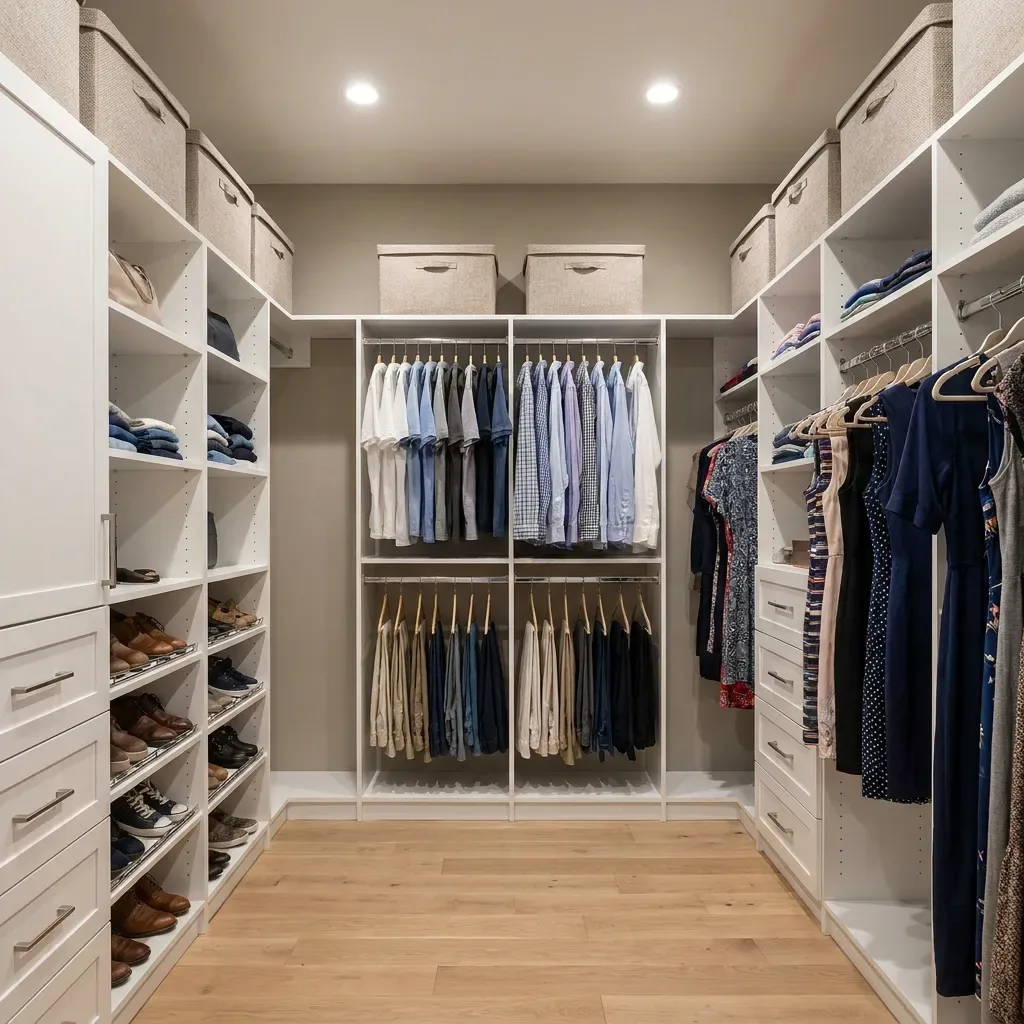
The walk-in quoted at $12,000 to $17,000
The homeowner had already done the rounds before they called us. They'd collected quotes from the big national closet brands for their primary walk-in, a real three-wall closet, and every number landed between $12,000 and $17,000. For one room.
We measured it, drew it and priced it the way we price everything: one installed number, no percentages. Double-hang in the middle, a long-hang section for dresses and coats, several banks of drawers, a full wall of angled shoe shelves and open shelving up top for bins, all in white furniture-grade melamine. $6,700, installed. Not a materials price, and not a figure that grew once the crew showed up.
It wasn't a smaller closet for the money, either. We quoted 14-inch-deep shelves where the national brands typically spec 12, so folded stacks and bins don't hang off the front edge. The homeowner kept somewhere between $5,300 and $10,300 they'd been bracing to spend. (The whole walk-in, wall by wall.)
We can't tell you how each of those quotes was put together. We can tell you that when the same closet, priced once, comes in that far under, the closet isn't what's driving the number. The pricing method is.
Every homeowner shopping for a custom closet runs into the same performance. You sit down for a quote, you hear a number that makes your stomach drop, and then — right on cue — the discounts begin. First it's 40% off. Then the salesperson finds another 15%. And then comes the closer: sign tonight, and there's another 10 to 20% on top.
Stacked up, it sounds enormous — 80%, sometimes pitched as almost the whole thing. It feels like winning. It's designed to.
But sit with it for one second, because the number tells on itself. No company can give away 80% of its price and survive. No manufacturer, no installer, nobody who pays for materials, labor, a truck and a crew can hand back the vast majority of its revenue and keep the lights on. So if the discount is that big and the company is still profitable, only one explanation is left: the price it was cut from was never real.
How can "80% off" still cost twice as much?
This is the part that gives it away. On the walk-in above, the national-brand quotes ran 1.8 to 2.5 times our installed price for the same closet. How does a number stay that high after a pile of percentages comes off it?
Simple: they marked it up first. Inflate a closet's "regular price" by around 300%, then take 40%, another 15% and a 10% sign-tonight bonus, and you still pay about 1.8 times what the work is worth. That's because stacked discounts multiply instead of adding: the pitch says 65% off, the invoice works out to about 54% off. Marking a product up 300% and then "discounting" it is not a discount. It's a gimmick. The percentage is theater; the only number that means anything is the one that actually leaves your bank account.
The arithmetic behind the gimmick
Run it with real numbers. Say the closet is quoted at $12,000, and after the stacked discounts you pay $3,600. The company just proved it will happily do the job for $3,600. So what was the other $8,400? Air — padding added to the list price for the sole purpose of taking it back off in front of you.
It works the same at every level. The bigger the discount a company advertises, the more it's confessing about its everyday price:
| Advertised discount | List price must be… | Air baked into the list |
|---|---|---|
| 20% off | 1.25× | +25% |
| 30% off | 1.43× | +43% |
| 40% off | 1.67× | +67% |
| 50% off | 2.00× | +100% |
| 60% off | 2.50× | +150% |
| 65% off | 2.86× | +186% |
| 70% off | 3.33× | +233% |
Read that table one more time, because it's the whole story. A 40%-off sale needs a list price 67% too high. Stack your way to 80% off and the list price has to be five times the real one. The discount isn't a gift to you — it's a measure of the markup.
Why nobody can actually give away 80%
Here's what genuinely goes into a custom closet: the materials themselves — we build in 3/4-inch furniture board, not wire — plus shipping from the manufacturer, sales tax, the designer who measures and draws your space, the crew that installs it, the truck, the insurance, and the warranty that has to be honored later.
Add those up on any honestly-priced closet and there is nowhere near 80% of the price sitting idle as margin. There isn't 40% either. A company that stacks 80% in discounts and still profits was never pricing the work — it was pricing the negotiation.
The tell is simple: ask yourself whether a grocery store could run 80% off milk every week, forever. It can't, because milk is priced honestly. When a discount can run permanently, it isn't a discount — it's the price.
The three tells of a fake discount
You don't need a spreadsheet to spot this. Watch for these:
1. The sale never ends. Check the company's ads from three months ago, and last year. If the "limited-time" 40%-off event has been running continuously, the regular price is decorative. A real promotion has a real end date and the company genuinely charges list the rest of the year.
2. The discount appears only after the flinch. If the big number comes first and the discount materializes in response to your reaction, you're not being quoted — you're being negotiated with, from a starting position designed to be abandoned.
3. Someone has to "call the manager." The phone call is theater. It exists to make the number you were always going to be offered feel like a favor someone fought for on your behalf.
What the FTC actually says about "regular price"
The rule here comes from the government, not from us. The Federal Trade Commission's Guides Against Deceptive Pricing (16 CFR 233.1) address it directly: a former or "regular" price must be a bona fide price — one the item was openly and actively offered at, for a reasonably substantial period of time. A figure invented to make a discount look larger isn't a former price; the FTC's guidance describes that as deceptive.
We're a closet company, not a law firm, and we're not accusing anyone in particular of anything. But the standard is public, and it's a useful yardstick when a number seems too generous to be real. The honest question to ask any company is simply: "How many of these did you actually sell at the regular price?"
Why the game works anyway
Inflated list pricing survives because it exploits something genuinely human. Psychologists call it anchoring, and Amos Tversky and Daniel Kahneman described it in their 1974 paper in Science on judgment under uncertainty: people estimate by adjusting from a starting value, and the adjustment usually falls short. The first number you hear becomes the reference point for every number after it. Hear $10,000 first, and $3,500 feels like a rescue — even if $3,500 was always the price, and even if a fairly-priced competitor would have done the same work for $3,200 without the performance.
Layer urgency on top ("this price is good today only") and the anchor does its job before you have time to compare anything. The discount isn't really aimed at your wallet. It's aimed at your decision-making.
What does a fake discount actually cost you?
The obvious cost is money — you may still be overpaying, because "80% off a fake number" tells you nothing about whether $3,600 is a good price for your closet.
But there's a quieter cost. You lose the ability to compare. When one company quotes a real price and another quotes a fantasy price with a dramatic markdown, the two numbers aren't speaking the same language. You end up comparing negotiating styles instead of closets — which is exactly the point.
And there's a third cost: pressure. Discounts that expire tonight exist to stop you from getting a second quote. Any company confident in its price is happy for you to go get one. And if you signed at your own table before you could, the FTC's Cooling-Off Rule generally lets you cancel a home sale of $25 or more until midnight of the third business day.
How we price instead
We price the job once, at the number we can actually do the work for, the first time you see it. There's no inflated "before" price to knock down and nothing to unlock by signing tonight.
That's why you'll never see us advertise 40% — let alone 80% — off: we never marked it up to begin with. A company that can stack 80% in discounts is telling you it had 80% of padding to give. We'd rather just leave it out and hand you the real number. That's the whole reason the walk-in at the top of this post came in at $6,700.
What our price includes, with nothing billed later: the in-home design consultation and measure, the materials, delivery and shipping, sales tax, professional installation by our own crew, and the warranty. Six things other companies quote as add-ons. See our full cost guide for what actually drives the number on a custom closet.
Seven questions to ask any closet company
Bring these to every quote — including ours. (The rest of what separates a good company from a forgettable one, from materials to who installs, is in our buyer's guide to choosing a closet company.)
1. What is the final installed price, with tax, delivery and installation included?
2. How long has the current sale been running, and when does it actually end?
3. How many jobs did you sell at the regular price in the last six months?
4. Is this price still available next week if I get a second quote?
5. What material and thickness are you using — and is it the same in the quote I'm comparing?
6. Is installation done by your own employees or subcontracted?
7. What exactly does the warranty cover, and for how long?
Question 4 is the sharpest one. A company with honest pricing will say "of course." A company running the discount game will suddenly find a reason the price might change.
How to compare quotes fairly
Ignore the percentage entirely. It's noise. Lay the quotes side by side and compare only the final installed price for the same scope — same materials and thickness, same number of drawers, rods and shelves, same accessories, delivery, tax, installation and warranty all in.
The only number that has ever mattered is what leaves your bank account. A stack of discounts on a number someone invented is worth exactly nothing.
Don't fall for it
When the discounts start stacking up — 40%, then 15%, then a sign-tonight bonus — don't ask "what a deal, how did they do that?" Ask the better question: "What was the price before they marked it up?" Then get one honest quote for the same closet and compare only the final installed numbers. If a fair everyday price beats a giant stacked discount, you have your answer.
You deserve a straight number from a company that will still be here to honor the warranty. That's how we price: one honest price, first time, every time. No countdown, no manager to call, no sale to wait for. Don't fall for it.
Sources
- eCFR: 16 CFR 233.1, Former price comparisons
- Tversky, A. and Kahneman, D. (1974). Judgment under Uncertainty: Heuristics and Biases. Science 185(4157)
- FTC Consumer Advice: Buyer's Remorse — the FTC's Cooling-Off Rule
Frequently asked questions
How do closet companies advertise 80% or more off?
They stack discounts: around 40% off, then another 15%, then a "book-tonight" bonus of another 10–20%. It only works because the starting "regular price" was inflated first — you can't really give away 80% of an honest price and stay in business.
How can a closet be 80% off and still cost twice the price?
Because the discount is off a made-up number. And stacked discounts multiply rather than add. Mark a closet up about 300%, take 40%, then 15%, then 10%, and a pitch that sounds like 65% off is really about 54% off, which leaves the price near double a fair one. Marking up 300% and then "discounting" isn't a discount — it's a gimmick.
Why doesn't National Closet Company offer 40% off?
Because we never added 40% to take back off. We price the job once, at a fair number for the same closet system, so there's nothing to hand back.
What does the FTC say about "regular price" claims?
The Guides Against Deceptive Pricing (16 CFR Part 233) say a former price must be bona fide — openly offered for a reasonably substantial period — not a figure invented to make a discount look bigger.
How do I compare custom closet quotes fairly?
Compare the final installed price for identical scope, and ignore the percentage entirely.
Searching for a California Closets sale? Start with what California Closets costs by project, so you know the number before any discount is taken off it.
Serving Nashville and all of Middle Tennessee — see our service areas, or book a free in-home design consultation and get a straight number.