
Home / Closet Cases / See Your Closet in 3D
Our Process · 6 min readSee Your Closet in 3D — Before You Ever Say Yes
Buying a custom closet usually means squinting at a salesperson's paper sketch, trusting a big number, and hoping it turns out like you pictured. We do it differently. At every free in-home consultation, we build your closet in 3D — right there, to your real measurements — so you see exactly what you're getting before you say yes. No paper drawings. Your closet, brought to life first.
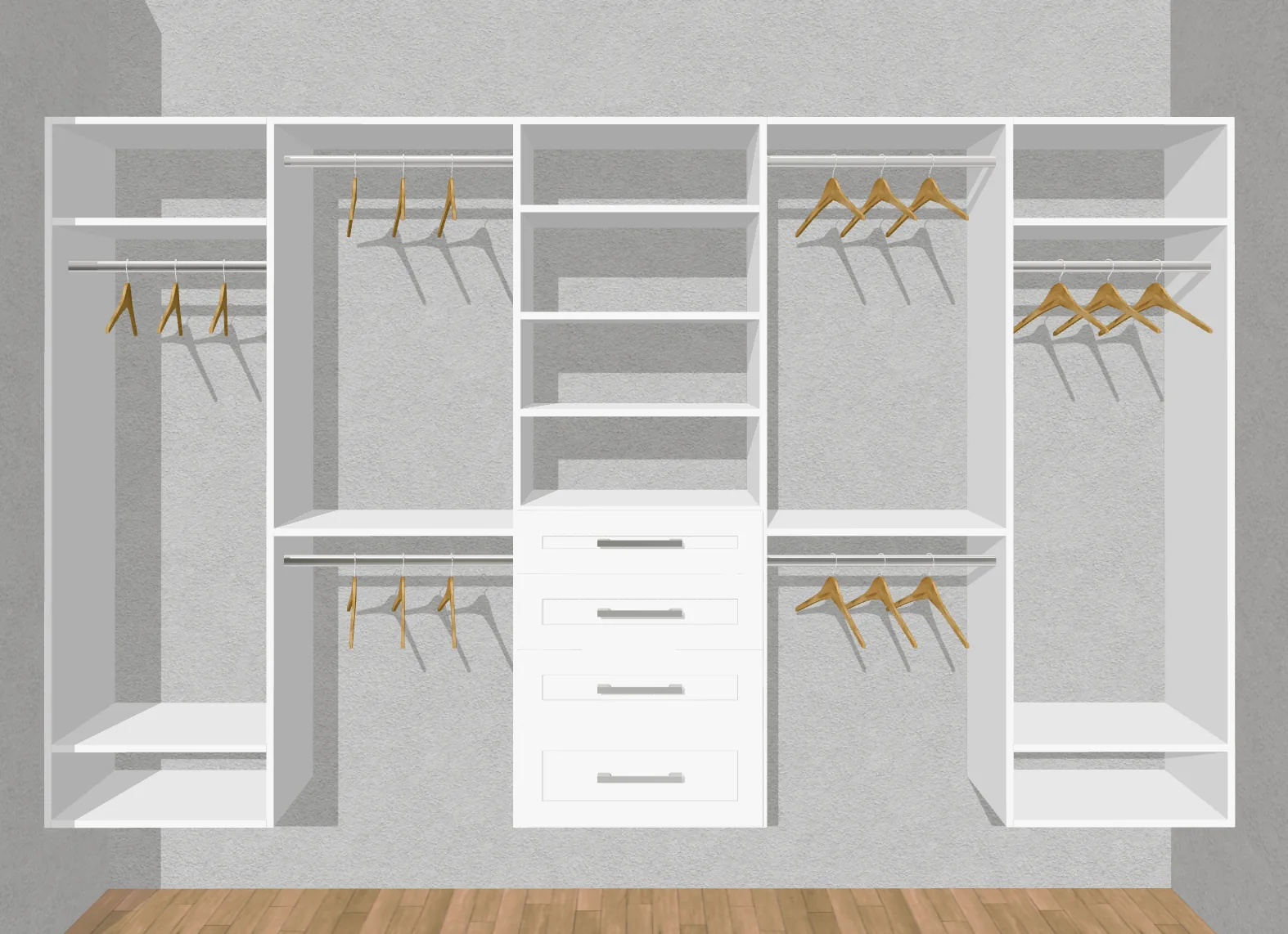
No paper drawings. A real 3D design.
Most closet companies hand you a flat sketch on a clipboard and ask you to imagine the rest. We don't think you should have to guess. During your consultation we measure your space and design your closet in 3D on the spot — drawn to the exact inches of your walls. You see every hanging section, every drawer, every shelf and shoe cubby, in proportion, in the actual room. And you can change it live: want more hanging and fewer shelves? A taller drawer stack? Shoe storage on the end? We adjust the design in front of you until it's right.
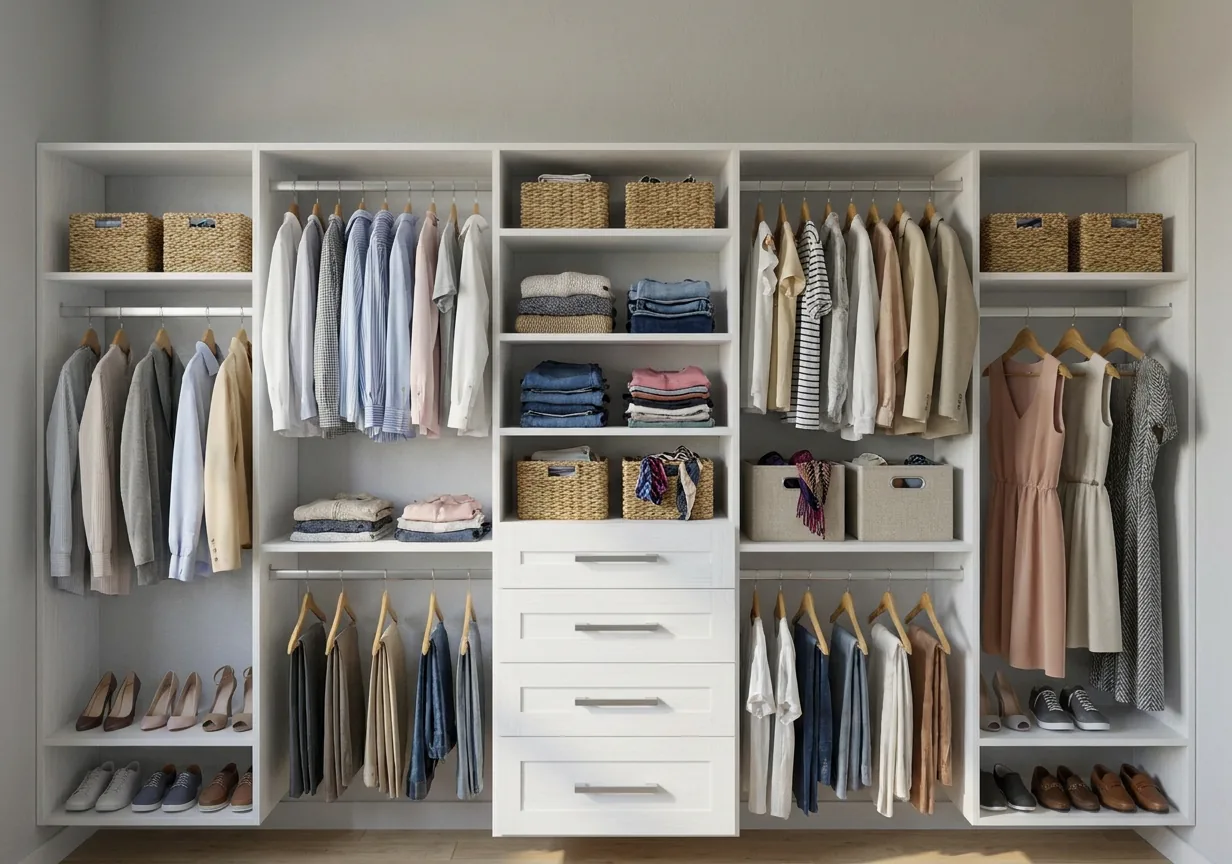
Will the finished closet match the design?
Because you're looking at a true-to-scale 3D model — not a rough sketch — there are no surprises on install day. What you approve on screen is what we build and install. It's the difference between "I hope this works" and "that's exactly what I wanted." You get to live with the design for a minute, picture your own clothes in it, and say yes with total confidence.
You shouldn't have to imagine your closet. You should be able to see it — before you spend a dollar.
The oldest trick in closets: the "National Price"
Here's the part nobody warns you about in how custom closets usually get sold. A salesperson measures your space, sketches a few lines on graph paper, taps at a tablet for a while, and then turns the screen around to show you a number that makes your stomach drop — a giant "National Price" or "list price." It's supposed to.
That number was never real, and federal pricing guidance agrees on what makes one real: under 16 CFR 233.1, a former price is a legitimate basis for a discount only if the item was actually offered at it, regularly, for a reasonably substantial period. It exists for exactly one reason: to make everything that happens next feel like a favor.
Then the performance begins. The salesperson "calls the manager." There's a special promotion running this week only. There's a sign-today bonus if you commit before they walk out the door. (If you sign in your own home anyway, the FTC's Cooling-Off Rule gives you until midnight of the third business day to cancel most sales of $25 or more.) The discounts start stacking up — 40% off, then another 20%, then a little more if you decide right now — until you're staring at a headline like "75% OFF!" and feeling like you'd be crazy to say no.
But 75% off a made-up number is still a made-up number. When the "National Price" was padded first, the 75% comes off the padding, and what's left can still sit well above what the closet should cost. You end up celebrating the size of the markdown while you overpay for the closet.
Why does a slashed “National Price” work on people?
The trick has a name: anchoring, which Tversky and Kahneman documented in a 1974 Science paper showing that people adjust too little from whatever starting number they're given. Anchor you to a wild number, slash it dramatically, and let the size of the "savings" distract you from the size of the check you're still writing. After the very biggest discount they'll ever offer, you can walk away still paying well over a fair installed price, and thanking them for the deal. (We wrote a whole piece on this — see why the "65% off" closet sale is a trap.)
…and all you've actually seen is graph paper
Now here's the real kicker. Through that entire pitch — the giant number, the manager phone call, the ticking clock, the stacked discounts — what have you actually seen? A handful of lines sketched on graph paper. You're being pressured to sign off on a big check for a closet you can't even picture, priced against a number invented to be crossed out. It's a system built to move fast and keep you from looking too closely at either the design or the real cost.
We think that's exactly backwards. You should see the closet clearly, and the price honestly — and then take all the time in the world.
Why is there no "National Price" here?
There's no "National Price" here, because there's nothing to discount down from. You get the honest installed price up front, sitting right next to your 3D design — no inflated list price, no manager phone call, no countdown, no pressure. This reach-in, with its double-hang sections, four-drawer center tower and dedicated shelf and shoe storage, was priced the same way: one installed number, the real one. You see the design and the price together, and you decide on your own schedule. Curious how projects like this are priced? Our custom closet cost guide lays out what moves the price, and you can browse more customer closet cases for ideas.
Book your free in-home 3D design
Ready to see your own closet come to life? Your in-home design consultation is completely free — we'll measure, design your closet in 3D, and give you an honest installed price, all in one visit, with zero obligation. We're family-owned and proud to serve Nashville and all of Middle Tennessee.
Sources
- eCFR: 16 CFR 233.1, Former price comparisons
- FTC Consumer Advice: Buyer's Remorse — the FTC's Cooling-Off Rule
- Tversky, A. and Kahneman, D. (1974). Judgment under Uncertainty: Heuristics and Biases. Science 185(4157)
Free in-home 3D design and an honest installed price, in one visit. No paper drawings.
Frequently asked questions
Everything you might be wondering before you book your free in-home 3D design.