
Home / Closet Cases / 12″ vs 14″ Shelf Depth
Closet Shelf Depth · 9 min readWhen Size Does Matter: 12″ vs 14″ Closet Shelf Depth
There's one closet-system spec that quietly decides how much your closet actually holds — and it almost never makes it into the sales pitch. It's shelf depth. Many national closet brands quote and install 12-inch-deep shelves because the shallower panel is cheaper to build, then call it "standard." The real standard is 14 inches — the depth your drawers, bins, hampers and shoe shelves are actually engineered for. Two inches doesn't sound like much. On a wall of shelving, it's the difference between everything fitting and everything hanging over the edge.
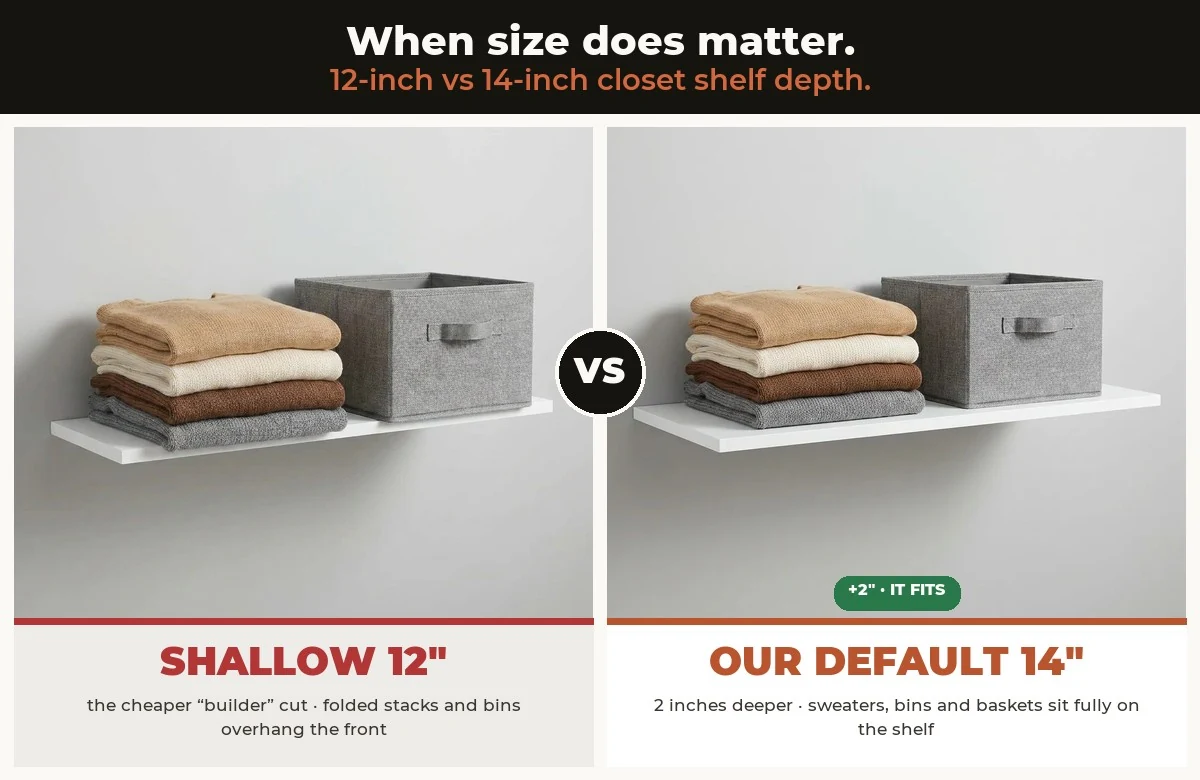
When you're comparing custom closet quotes, you naturally look at the big, obvious things: the price, the finish color, the number of drawers, whether there's a place for your shoes. Almost nobody asks about the depth of the shelves. And that's exactly why it's the corner so many companies quietly cut.
Here's the short version, before we dig in: the standard depth for a custom closet shelf is 14 inches. A lot of the national brands install 12 inches instead, because a 12-inch panel uses less material and costs them less to manufacture. You're rarely told this, and you rarely see the savings. What you do see — later, after it's installed — is that your folded sweaters overhang the front edge, your storage bins won't sit flush, and half the accessories you wanted won't even fit. In closets, size really does matter.
What is the standard depth of a closet shelf?
For a custom closet system, 14 inches is the standard shelf depth, and it's standard for a reason. Fourteen inches is the sweet spot that comfortably holds the things people actually keep in a closet:
A folded sweater or a stack of jeans sits fully on a 14-inch shelf without drooping over the front. A standard shoebox turns sideways and fits. A fabric storage bin or a woven basket — the kind everyone buys to corral accessories, hats and off-season clothes — sits squarely with a little breathing room. And critically, 14 inches matches the cabinet depth that closet accessories are built around: deep drawers, pull-out hampers, valet rods, tie and belt racks, and angled shoe shelves.
Twelve inches, by contrast, is what the cabinet and shelving industry treats as a shallow, space-saving depth — great when you genuinely need to save space, and a problem when it's used everywhere just to trim cost.
Why do national closet brands quote 12-inch systems?
It comes down to material. A closet system is mostly flat panel — shelves, dividers, drawer boxes, cabinet sides. Every one of those parts gets cut from the same 3/4-inch board. Drop the depth from 14 inches to 12 and you shave roughly 15% off the panel on every horizontal surface in the closet. Multiply that across a full walk-in with dozens of shelves and drawer boxes, and the manufacturer saves a meaningful amount of material on every single job.
That savings is real — for them. The catch is that it's almost never handed to you as a lower price, and it's almost never disclosed as a downgrade. The 12-inch shelf gets quoted as "standard," the number looks competitive, and the depth difference only shows up once your closet is on the wall and your bins are hanging off the front of it.
We wrote about the pricing side of this in our piece on fake closet discounts — the 12-inch shelf is the physical version of the same idea: quietly give you less, so the number looks better than the closet actually is.
The real problem: standard accessories don't fit in 12 inches
This is where a shallow closet quietly costs you. The upgrades that make a custom closet feel custom — the drawers, the hampers, the shoe storage — are engineered around a 14-inch depth. Put them in a 12-inch system and you run into walls:
Deep drawers and jewelry drawers. Standard closet drawer boxes are built for 14-inch cabinets. In a 12-inch system they either won't fit, have to be special-ordered shallower (holding less), or stick out past the face of the closet. Velvet-lined jewelry drawers and divided accessory drawers are especially unforgiving — lose two inches and you lose a full row of storage.
Pull-out hampers and laundry baskets. A tilt-out or pull-out hamper needs the full depth to hold a real load. Shallow it down and you've got a hamper that holds a couple of shirts.
Shoe shelves. A men's size-11 shoe is around 12–13 inches long. On a flat 12-inch shelf, the toes hang off the front; on angled shoe shelves, shallow depth means the heel drops off the back. Fourteen inches keeps a full range of shoe sizes fully supported.
Storage bins and baskets. The standard fabric cube and most closet baskets are sized for a 14-inch shelf. On 12 inches they overhang, tip forward when you pull one out, and never look tidy.
Folded stacks. A neatly folded sweater is often 13–14 inches front to back. On a shallow shelf, the whole stack drapes over the front lip — the exact thing you can see in the photo above.
| What you're storing | Fits a 12″ shelf? | Fits a 14″ shelf? |
|---|---|---|
| Folded sweaters & jeans | Overhang the front | Yes — flush |
| Standard fabric bins & baskets | Tip & overhang | Yes |
| Men's / larger shoes | Toes or heels hang off | Yes |
| Deep & jewelry drawers | Shallow-order only | Full-depth |
| Pull-out hamper | Small capacity | Full capacity |
The math: how much storage you lose
Two inches per shelf sounds trivial until you add it up. On a single 4-foot shelf, going from 14 inches to 12 costs you about 96 square inches of surface — roughly the footprint of two more folded stacks. Now count the shelves in a real walk-in: eight, ten, a dozen or more, plus the tops of every cabinet and the floor of every drawer. Across the whole closet, choosing 12-inch depth can quietly erase the equivalent of an entire extra shelf tower of storage — while the closet takes up exactly the same wall.
That's the part that stings. You're not saving floor space by going shallow — the closet is the same size in the room. You're just holding less inside it.
"But my room is small" — when 12 inches is the right call
To be clear: 12-inch depth is not a villain. There are rooms where it's genuinely the smart choice, and we install it on purpose all the time:
In a shallow reach-in closet where a 14-inch cabinet would crowd the hanging space or block the doors from closing. Along a wall where a deeper cabinet would bump into a doorway swing, a window, or a light switch. In a tight walk-in where trimming a run to 12 inches buys you the extra couple of inches of walkway that make the room comfortable to stand in. And in kids' rooms and secondary closets where the loads are lighter and the space is at a premium.
The difference is intent. Choosing 12-inch depth on a specific run, for a specific reason in your space, is good design. Being quoted 12 inches everywhere because it's cheaper to manufacture is a downgrade wearing the word "standard."
How we do it: 14″ by default, 12″ when it's smart
At National Closet Company we default to a full 14-inch depth on every custom closet — walk-in, reach-in, wardrobe and pantry alike — so your shelves hold more and every accessory you might want actually fits. You don't have to know to ask for it, and you don't pay a "premium" to get the depth that should have been standard in the first place.
Then, where your room calls for it, we'll install 12-inch depth by design or by request — a shallower run past a door swing, a narrower tower to keep a walkway open, a reach-in that simply isn't deep enough for 14. You'll know exactly where and why, because we'll show you in the 3D design before anything gets built. See how our 3D design process works →
It's the same philosophy behind everything we build: give you the better spec as the baseline, and only deviate from it when your space genuinely benefits — not when our cost sheet does.
Reach-in vs. walk-in: depth still matters
People assume depth is only a walk-in concern, but it matters just as much in a reach-in closet. A reach-in already gives you a narrow footprint, so every inch of usable shelf depth counts double. Fourteen-inch shelves let a reach-in swallow full folded stacks and real bins instead of forcing everything to perch on the edge. In a walk-in, deeper shelving means the perimeter towers do more work, so you need fewer of them — which can actually open the room up. Either way, the depth of the shelf is doing quiet, constant work every time you put something away. More on reach-in vs. walk-in closets →
How to check the depth on any closet quote
You can protect yourself in about thirty seconds. On every quote you're comparing — including ours — ask these:
1. What is the shelf depth, in inches? Get a number, not "standard." If it's 12, ask why.
2. Is the depth the same everywhere, or does it change by section? Good — depth should vary where the room needs it.
3. Will my drawers, hampers and shoe shelves be full-depth? Shallow accessories in a shallow box hold noticeably less.
4. If I want 14-inch shelves, is that an upcharge? With us, 14 inches is simply the default.
Then look at the drawing. A quote that lists depths, and explains where they change and why, is from a company designing for your space. A quote that's silent on depth is hoping you won't ask.
Size matters — in the direction that helps you
A custom closet is supposed to give you more: more usable space, more of your things put neatly away, more room than the builder-grade shelf you're replacing. Shave two inches off every shelf to make a number look better, and you've quietly handed a chunk of that back before you ever move in.
So when you're comparing closet systems in Nashville or anywhere across Middle Tennessee, don't just compare prices and finishes — compare the depth. Ask the question, look for 14 inches as the baseline, and make sure any 12-inch run in your closet is there because your room wanted it, not because it was cheaper to build.
Frequently asked questions
What is the standard depth of a closet shelf?
Fourteen inches. It holds folded stacks, bins and shoes without overhang and matches the depth most closet accessories are engineered for. Many national brands install 12-inch shelves because the shallower panel costs them less.
Why do closet companies use 12-inch shelves?
Because 12 inches uses about 15% less panel material per shelf, saving the manufacturer money on every job — savings you rarely see, quoted as "standard."
Do closet accessories fit in a 12-inch closet?
Often not. Deep drawers, jewelry drawers, pull-out hampers, shoe shelves and most fabric bins are built for 14-inch cabinets and either won't fit or must be special-ordered shallow.
Does National Closet Company build 12-inch or 14-inch closets?
We default to 14-inch depth on every closet, and install 12-inch runs where a tight reach-in, a door swing or a narrow walk-in makes it the smarter choice — by design and by request, not as a hidden default.
Serving Nashville and all of Middle Tennessee — see our service areas, or book a free in-home design consultation and we'll show you your closet, at full depth, in 3D before anything is built.